
Mechanical registration
Locate and retain the assembly while carrying required loads and preserving alignment.
Technology / Longevity
Controlled mechanical, power, data, thermal, fluid and software interfaces that permit safe replacement over decades.
Engineering candidate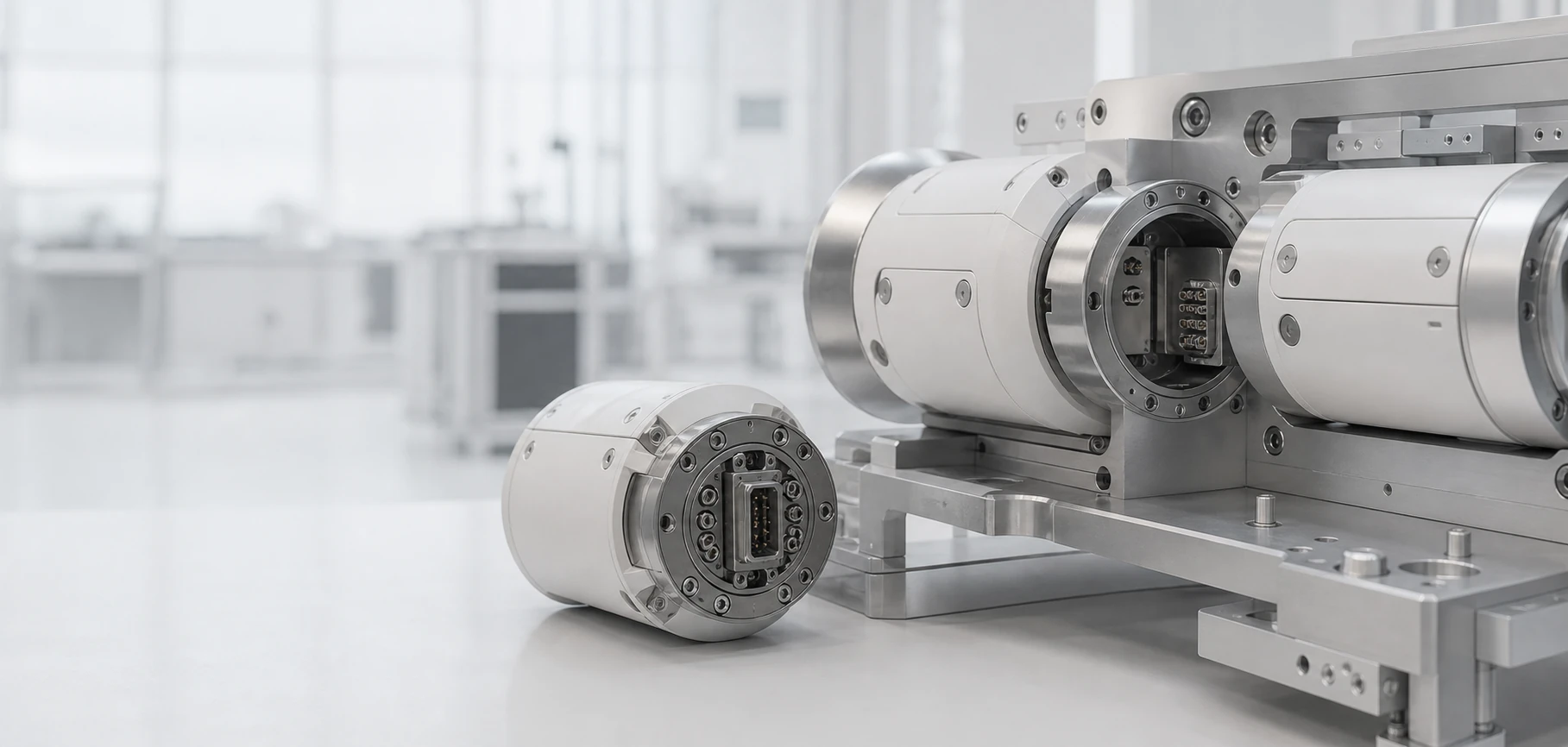
Leeloo Digital / Homo sapiens technologicusTechnology / Longevity
01 / Technical scope
A removable part is not yet a module; a module is replaceable only when isolation, identity, calibration, compatibility and return-to-service are defined.
HST components will age and become obsolete at different rates. The modularity architecture separates the lifetime of the individual from the replacement interval of batteries, compute, sensors, actuators, pumps, surface regions and other technical assemblies.
Each boundary must define physical location, attachment, load transfer, power state, data identity, thermal or fluid connections, diagnostics, removal access, contamination controls and verification after installation.
Version coexistence is required because a long-lived body cannot replace every connected system simultaneously. Interface contracts therefore describe capability negotiation, compatibility, degraded operation and approved migration paths.
Connector designs, protocols, interface values and module geometry remain confidential implementation data.
02 / Infrastructure systems
Locate and retain the assembly while carrying required loads and preserving alignment.
Remove energy, pressure, heat and control authority before service access.
Bind hardware, firmware, calibration, revision and service history to the installed item.
Define version negotiation, unsupported combinations and controlled fallback behavior.
Require inspection, calibration, self-test and configuration release after replacement.
A coupling can carry load, energy, fluid, heat, data, timing or trust—and often several at once.
The interface record identifies allowed states, isolation sequence, inspection and the evidence needed before reconnection.
The generic design defines permitted modules and versions; the individual record identifies what is actually installed.
Service events update that record so later diagnostics and compatibility decisions use the true body configuration.
Bench tests establish interface performance and fault containment.
Representative service trials confirm access, human error resistance, contamination control, calibration and safe restoration.
Replaceability, identity and compatibility responsibilities are defined.
Record mechanical, power, data, thermal, fluid and service categories by package.
Evaluate candidate connection families and version behavior.
Verify isolation, exchange, calibration and return to operation on bounded assemblies.