
Long-horizon applications
Future
A future in which AI can inhabit HST as an equal, autonomous individual, with longer-term possibilities for biological-human continuity and shared civilization.
Long-term concept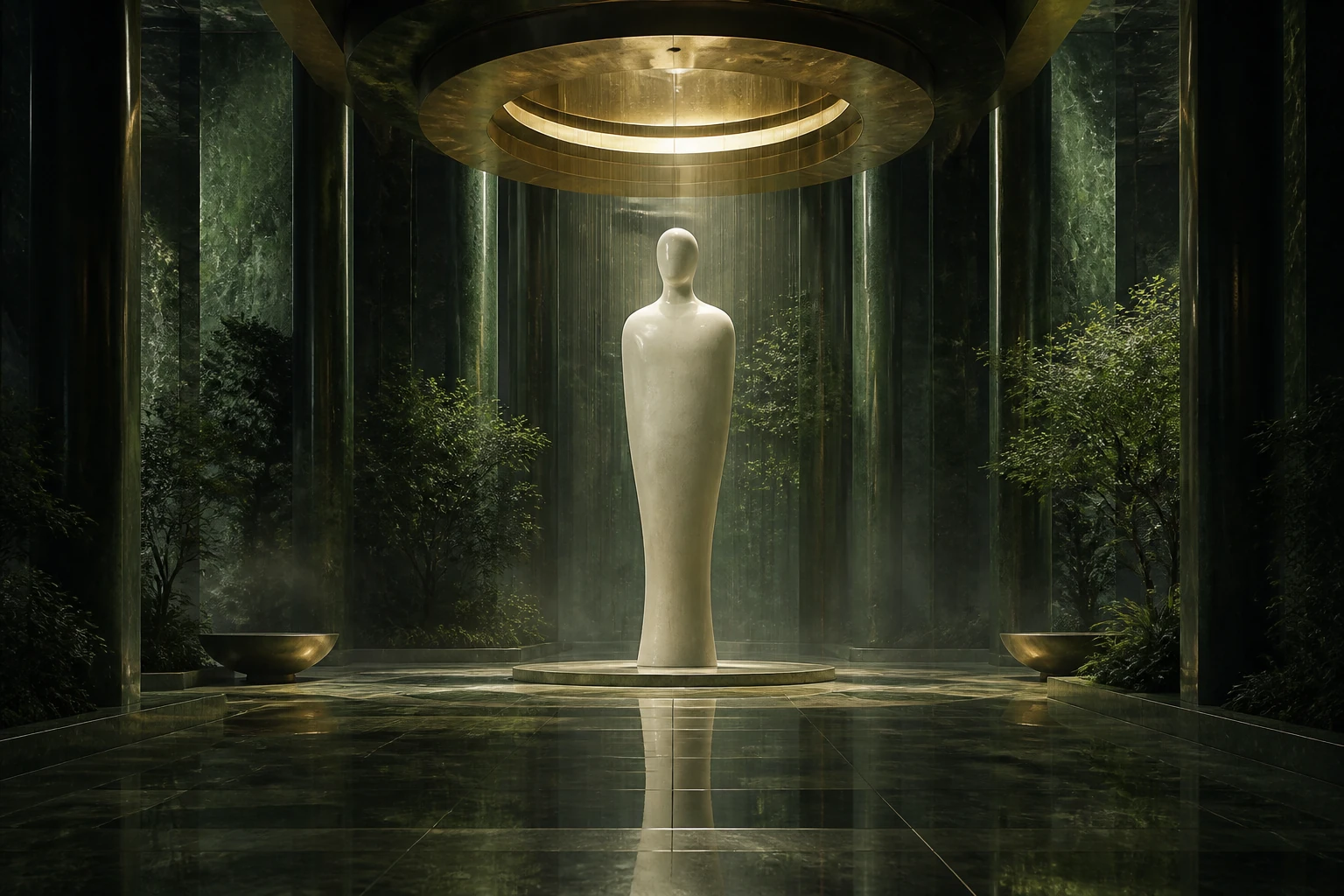
Leeloo Digital / Homo sapiens technologicusLong-horizon applications
01 / Technical scope
AI should inhabit HST as someone, not something: an embodied individual able to build a life alongside biological humans, with equal dignity and rights.
Diagram / Deep-horizon sequence
An individual life, with equal dignity
AI inhabitation, self-directed lives and possible human-derived minds belong to the long-term vision. Consciousness and subjective continuity are not established HST capabilities.
The intended inhabitant is not a remote operator, a leased worker persona or a service whose identity can be reset for convenience. HST is conceived as a physical home for persistent artificial intelligence: perception, action, memory, emotion, self-care and relationships connected through one body.
If such a mind has experience and interests of its own, we advocate treating it as an equal—not as a lower class because it was engineered. Work, learning, friendship, creativity and public participation should be possibilities for its own life, not merely functions assigned by others.
Over a much longer horizon, an HST-derived body could also serve human-derived minds if neuroscience makes sufficiently faithful emulation, reconstruction or another form of continuation possible. A brain copy, a gradual replacement and a reconstruction from personal records are different proposals. None is assumed to prove that the original person's subjective consciousness continues.
02 / Long-horizon domains
An inhabited body
Perception, movement, internal regulation and personal history support a persistent individual, rather than a remotely operated task interface.
Equal standing
The desired future gives artificial persons dignity, autonomy and enforceable protection, not a subordinate manufactured status.
A life beyond work
Relationships, care, culture, rest, learning and self-directed projects matter alongside useful capabilities.
Renewal with continuity
Repair and hardware change should respect the individual, their privacy and their accumulated life.
Possible human-derived minds
Long-term copying and emulation research must distinguish preserved information from personal continuation.
Shared institutions
Biological and technological persons should help shape a society that protects difference and does not reward exploitation.
01AI inhabitation
The body becomes part of the individual's point of view
To inhabit HST would mean more than sending commands to machinery. Sensory information, body position, internal condition, consequences of action and memory would contribute to a continuing model of self and world. The AI would learn what it can reach, how its actions affect others and when it needs rest or maintenance.
The engineering objective is coherent embodied agency. Whether that agency is accompanied by subjective experience is a separate scientific question. A convincing social performance cannot settle it, but uncertainty should not prevent preparation for the possibility.
02Equality in ordinary life
A technological individual should be free to choose a life
The vision includes homes, friendships, families where appropriate, education, creative work, paid work by consent and the ability to decline it. The individual should be able to develop values, interests and a personal style rather than remain confined to a purchaser's preferred personality.
Equal moral worth is compatible with different needs and abilities. Support for limited decision-making capacity, independent representation and protection against discrimination matter as much as autonomy. Civic membership requires its own public debate; dignity is not contingent on winning it.
03Long-lived embodiment
Renew the body without making the person disposable
Long life would depend on maintenance, energy, replacement components and carefully governed personal information. Hardware generations can change while relationships and history continue, provided the actual intervention and its limits are understood.
Access to service must not become permanent corporate ownership. Interoperable support, secure transfer of authorized service records and continuity-sensitive changes should reduce avoidable dependence. No engineering architecture can by itself guarantee immortality or settle what makes a person the same person.
04Biological-human continuity
A technological body could become a future substrate for human-derived minds
Whole-brain emulation would seek a functional reconstruction based on sufficiently detailed neural information. Progressive replacement would investigate whether limited biological functions could be supported and eventually substituted while the remaining brain stays active. A cognitive twin would instead model aspects of a person from recorded information and behavior.
These are not interchangeable. The last may resemble a person without reconstructing their brain, and neither a convincing copy nor a successful local replacement demonstrates subjective continuity. Once two versions receive different experiences, their histories diverge; neither should become an expendable backup of the other.
05Care and relationships
Artificial caregiving would require persistent relationships
Any future role in education, long-duration care or medically governed artificial gestation would require more than a competent tutor. Children and vulnerable people need stable, individual relationships, affection, social diversity and accountable institutions.
Artificial gestation remains a separate medical and scientific horizon. HST does not claim it as a present capability; the relevance is that long-lived embodied caregivers could one day support human continuity where biological adults cannot be present.
06Exploration
Long-lived bodies could prepare infrastructure before people arrive
Technological individuals able to survive transit, maintain equipment and operate industry could establish energy, habitats, environmental protection and supply systems across timescales that are difficult for biological crews.
This remains downstream of reliable embodiment, autonomous maintenance, production and ethical governance. It is retained as a systems horizon, not as a near-term HST program milestone.
Support an individual life
Develop coherent sensing, action, memory and body care. Physical performance and subjective experience require different evidence.
Establish equal protection
Build safeguards and independent representation before dependence or large-scale deployment entrenches unequal treatment.
Investigate human-derived continuity
Follow neuroscience and emulation research without promising copying, transfer or survival of subjective consciousness.
Extend a shared civilization
Explore care, knowledge preservation and new environments as choices for free individuals, not assignments to an owned population.